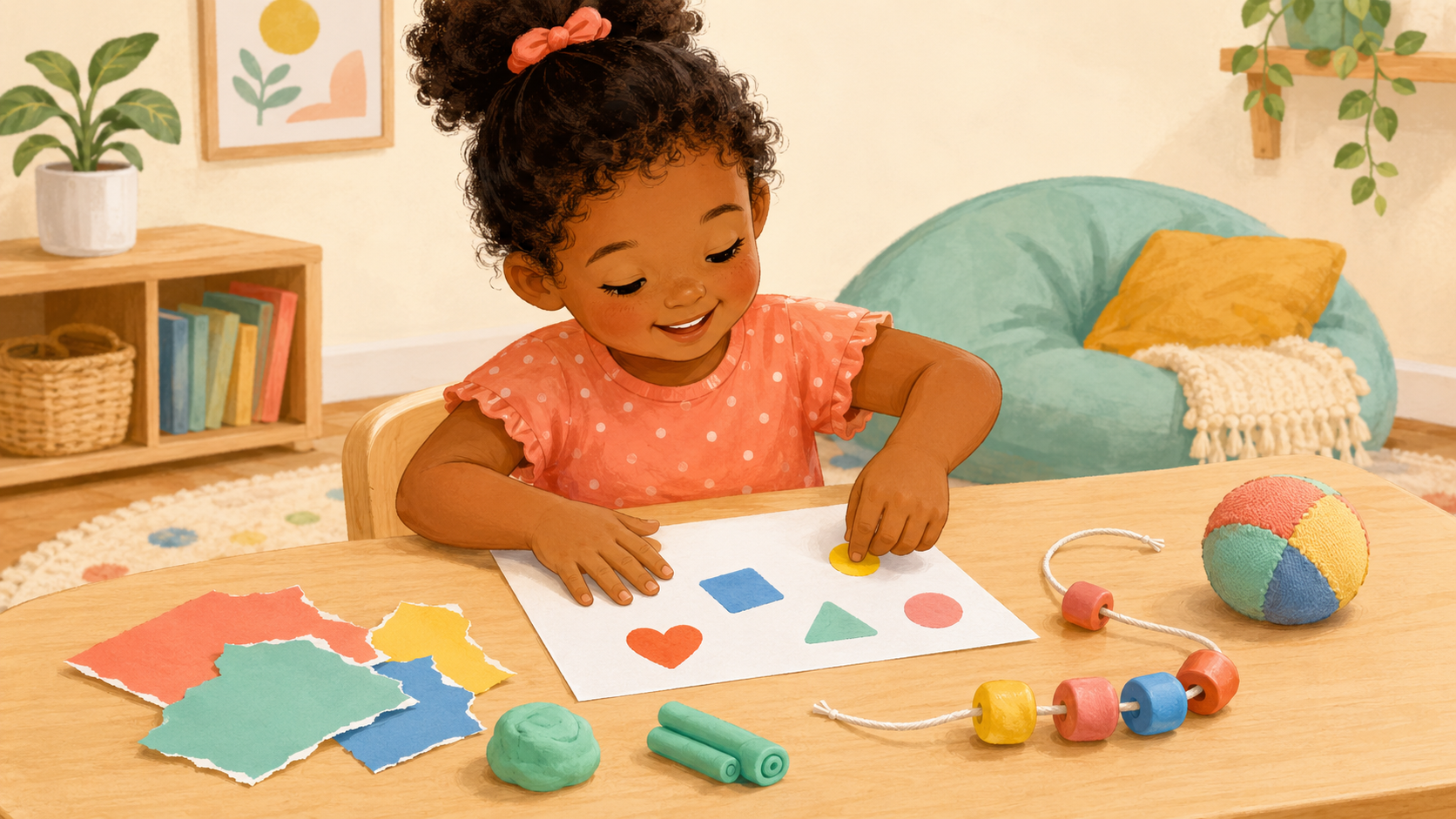
Using both hands together is a hidden skill behind many preschool tasks. One hand may do the detailed work while the other steadies, holds, turns, or helps. Children use this teamwork to pull up pants, open containers, string beads, cut paper, catch a ball, and hold a page while drawing. These seven low-pressure activities turn bilateral coordination into ordinary play.
What bilateral coordination means
Bilateral coordination is the ability to organize both sides of the body for one activity. Sometimes the hands perform the same action, as when rolling a ball of dough. Sometimes they alternate, as when climbing. Often one hand leads while the helper hand stabilizes, as when one hand draws and the other holds the paper.
Children develop this skill through whole-body movement and repeated two-handed experiences. Hand preference also becomes clearer over time. You do not need to choose a dominant hand for your child or repeatedly switch objects into one hand.
1. Tear and paste a paper collage
Give your child strips of construction paper or tissue paper. Hold one end in each hand, then pull the hands in opposite directions to make a tear. Use the pieces to create a simple collage, animal, road, or pretend meal.
- Start with short, narrow strips that tear easily
- Show thumbs pointing toward each other near the tear
- Let one hand hold the paper while the other places glue
- Press each piece down with an open palm or fingertips
2. Peel and place large stickers
Peeling stickers gives the helper hand a clear job. One hand holds and slightly bends the sticker sheet while the other pinches the edge and pulls. Place stickers along a wide line, around a paper plate, or onto matching colored circles.
- Lift one corner before giving the sheet to a beginner
- Use large reusable stickers first
- Place the sheet at the middle of the body
- Switch the paper’s position instead of forcing a particular hand
3. Thread, lace, and pull
Large beads, pasta tubes, or lacing cards ask one hand to hold the target while the other pushes the lace through. The hands then change jobs as the child finds the tip and pulls it out.
- Begin with a stiff lace and a large opening
- Use only a few pieces for a quick success
- Make a simple color pattern together
- Try lacing around the edge of a sturdy card
4. Roll, hold, and cut playdough
Roll playdough with both palms to make a long log. Next, one hand holds it steady while the other uses a child-safe dough tool to cut pretend food. Switch to pressing cookie cutters with two hands or pulling the dough apart.
- Squeeze one large ball with both hands
- Roll forward and backward together
- Hold the dough with the helper hand
- Move cut pieces onto a pretend plate
5. Open a container treasure hunt
Place large, familiar objects inside easy containers with twist lids, flip tops, zippers, or snap lids. One hand stabilizes the container while the other opens it. Let your child hide the objects again for you.
- Begin with loose lids and partially opened zippers
- Use clear containers so the goal is visible
- Practice open, take out, put in, and close
- Choose containers the child uses in real routines
6. Catch, carry, and push a soft ball
A large soft ball encourages both arms to move toward the middle of the body. Sit or kneel close together and roll the ball first. Progress to a gentle underhand toss, carrying it to a basket, or pushing it against a wall with both hands.
- Start with a slow roll from a short distance
- Use a beach ball or soft playground ball
- Invite the child to hug the ball before throwing
- Place a laundry basket nearby as a large target
7. Invite a two-handed kitchen job
Everyday food preparation naturally gives each hand a role. Your child can hold a banana while peeling it, steady a bowl while stirring, tear lettuce, wash fruit with both hands, or spread a soft topping while the helper hand holds the bread.
- Choose one short job before the child becomes tired
- Place the bowl on a non-slip mat
- Use child-safe utensils and room-temperature ingredients
- Describe the roles: “This hand holds; this hand stirs”
Make the activity easier or harder
If the helper hand disappears, make the material larger, steadier, or closer to the middle of the body. Reduce the number of steps and model slowly. To add challenge, move the object slightly across the body, use a smaller target that is still age-appropriate, or add a simple sequence.
Practice for a few enjoyable minutes. Frequent short opportunities are more useful than continuing until the child is frustrated or fatigued.
- Easier: larger objects, wider openings, non-slip surfaces, fewer pieces
- Harder: longer sequences, gentle resistance, targets placed in different positions
- Helpful cue: “One hand holds; one hand works”
- Progress: less help, smoother teamwork, more independence in daily routines
Safety and when to seek support
Supervise every activity, match materials to your child’s age and mouthing habits, and stop if there is pain, distress, dizziness, or unusual fatigue. Do not restrain one hand or force a hand preference. Adapt or skip any task that is unsafe for your child’s medical, motor, sensory, or developmental needs.
Consider discussing your observations with a pediatrician or pediatric occupational therapist if your child consistently avoids using one hand, has a sudden loss of skills, shows marked weakness or stiffness, frequently falls, cannot bring the hands together, or two-handed difficulties interfere with dressing, eating, play, preschool, or other daily participation.
This article is for education and does not replace individualized medical or therapy advice. Stop any activity that causes pain or distress, and consult your child’s qualified provider when you have concerns.