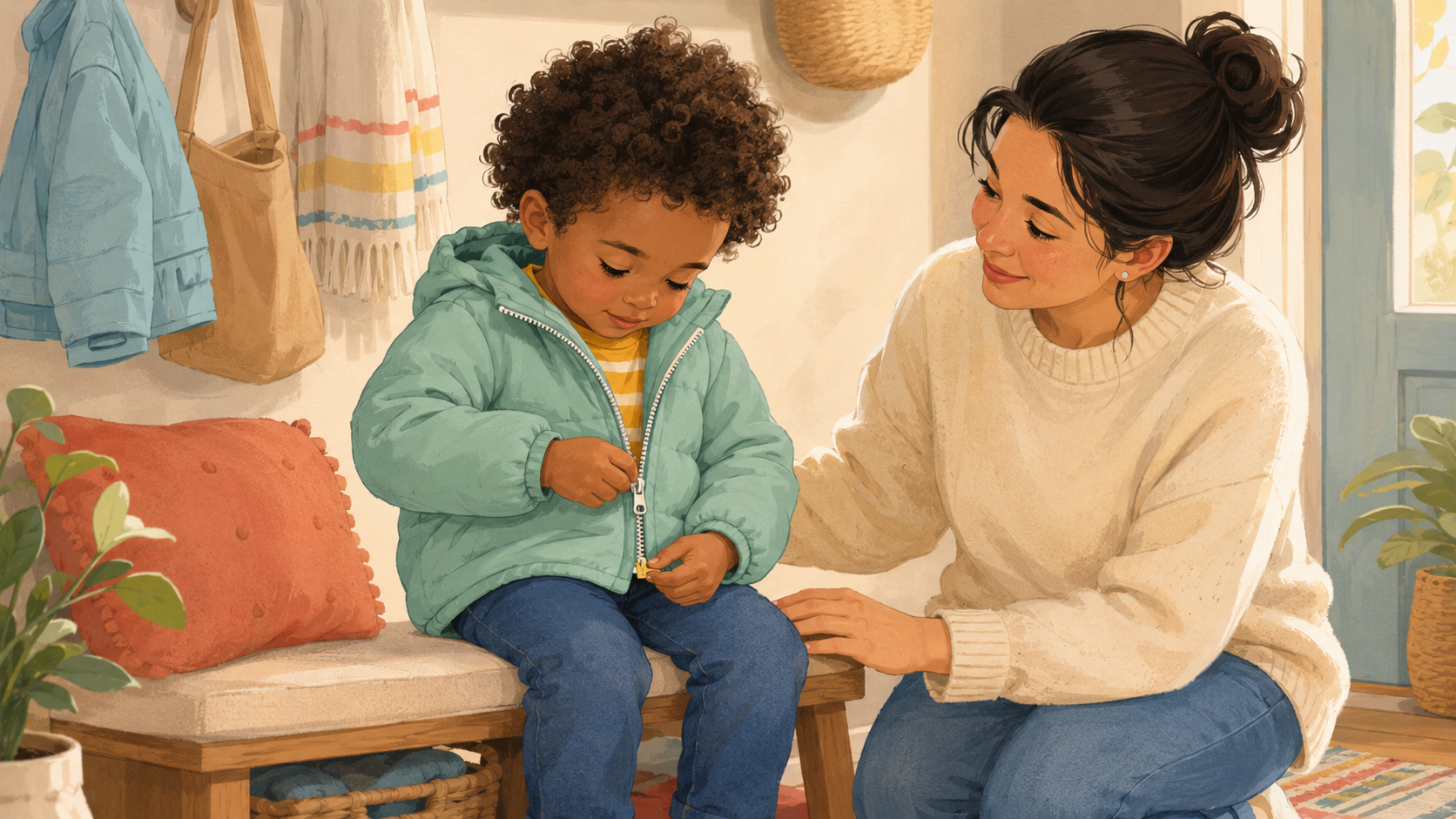
A zipper asks two hands to do different jobs at the same time. One hand must hold the bottom box steady while the other lines up the pin, pushes it fully down, and then pulls the tab upward. The child also needs visual attention, finger strength, body stability, and patience. Many preschoolers can practice parts of this task before they can start a separating jacket zipper independently. Teach one small step at a time and let success grow from there.
Begin with the easier zipper jobs
Opening a zipper that is already joined is usually easier than connecting the two sides. Let your child first pull zippers on a pencil case, backpack, pouch, or jacket while the garment rests on a table. Then practice pulling a jacket zipper down, separating it at the bottom, and finding the pull tab.
These early jobs build confidence and teach the direction of movement without asking the child to solve every part at once.
- Pull a large zipper open and closed on a bag
- Find and pinch the zipper tab
- Hold the fabric with the helper hand
- Pull slowly to the end of the track
- Practice for two or three successful turns
Use a stable, easy-to-see position
Practice when no one is rushing. First place the open jacket on a table with the zipper facing up and the bottom pointing toward the child. Later, have the child sit with feet supported while wearing the jacket. A stable body gives the eyes and hands more control.
Use good lighting and move bulky scarves, backpack straps, long hair, and loose fabric away from the zipper path.
- Feet rest on the floor or a firm step
- Elbows stay close to the body
- The zipper bottom is centered and visible
- The jacket is the correct size and fully open
- An adult sits beside the child rather than reaching from behind
Teach four short words: hold, in, down, up
Long explanations can overload a child who is already coordinating both hands. Use the same four cues each time and demonstrate slowly beside the child.
- Hold — pinch the bottom box and fabric with the helper hand
- In — guide the pin into the opening
- Down — push the pin all the way to the bottom
- Up — keep holding the bottom while the other hand pulls the tab
Use backward chaining for an early win
Backward chaining means the adult completes the harder beginning and the child finishes the last step. Join the zipper and pull it up one or two inches, then let the child pull it to the top. Next time, stop closer to the bottom. Gradually give the child more of the sequence.
This approach lets the child experience a completed zipper while practicing the most manageable movement first.
- Adult joins the zipper; child pulls to the top
- Adult inserts the pin; child holds the bottom and pulls
- Child pushes the pin down after the adult lines it up
- Child lines up, inserts, holds, and pulls with verbal cues
- Fade the cues when the sequence becomes familiar
Build the small skills through play
Zipper practice works best alongside playful activities that strengthen the same foundations. Keep materials large enough for your child and supervise closely.
- Open zippered pouches to find toy animals or puzzle pieces
- Use clothespins to clip pretend laundry
- Pull stickers from a sheet and place them on a line
- Push craft sticks through a slot in a box
- Thread large cards or beads on a thick lace
- Hold a container with one hand while the other opens the lid
Make the zipper easier without hiding the skill
A larger commercial zipper pull can make grasping easier, but it should be securely attached, short, and appropriate for a young child. Some adaptive jackets use magnetic zipper bases that reduce the precision needed to connect the two sides. These can support participation while the child continues building hand skills.
Before buying anything, try a jacket with a large contrasting zipper, smooth track, and firm bottom box. Often the right garment is the most useful adaptation.
- Choose a zipper color that contrasts with the fabric
- Rub a dry zipper only as the manufacturer recommends
- Keep the jacket flat and untwisted
- Avoid long cords, loops, or homemade dangling pulls
- Replace a zipper that catches, separates, or has sharp edges
Support sensory comfort and frustration
The sound, pressure near the chin, scratchy fabric, tight collar, or sudden tug can feel uncomfortable. Ask what the child notices and change one feature at a time. Practice with the jacket off the body if wearing it adds too much sensory demand.
Keep the tone neutral when the zipper misses. Say, “The pin is not at the bottom yet—let’s reset,” instead of “You did it wrong.” A brief pause, one slow breath, and a simpler step can protect the child’s willingness to try again.
- Let the child choose between two comfortable jackets
- Fold the collar away from the neck
- Warn before helping the hands
- Use a mirror only if it clarifies rather than distracts
- End after one calm success
Troubleshoot the exact step
Watch where the sequence breaks down. A child who can pull the tab but cannot start the zipper needs different practice from a child who loses the helper-hand hold.
- Pin misses the box: practice posting craft sticks into a slot
- Pin goes in but zipper separates: push fully down before pulling
- Bottom rises with the tab: mark where the helper hand should hold
- Tab is hard to grasp: choose a larger secure pull
- Fabric catches: flatten the jacket and clear the zipper path
- Child forgets the order: use four simple pictures for hold, in, down, up
Safety and when to seek support
Supervise young children while they learn. Keep skin, hair, scarves, drawstrings, necklaces, and loose fabric away from the zipper. Use only short, secure pulls that cannot form a loop around the neck or detach into a choking hazard. Do not yank a stuck zipper. Stop for pinched skin, pain, swelling, fear, or a damaged sharp edge.
Talk with your child’s pediatrician or a pediatric occupational therapist if dressing difficulties regularly affect preschool participation, outdoor play, family routines, or the child’s confidence; if there is pain, weakness, marked one-sided use, frequent loss of skills, or difficulty with many two-handed tasks. An OT can look at posture, vision, hand skills, sensory needs, motor planning, and the clothing itself.
This article is for education and does not replace individualized medical or therapy advice. Stop any activity that causes pain or distress, and consult your child’s qualified provider when you have concerns.