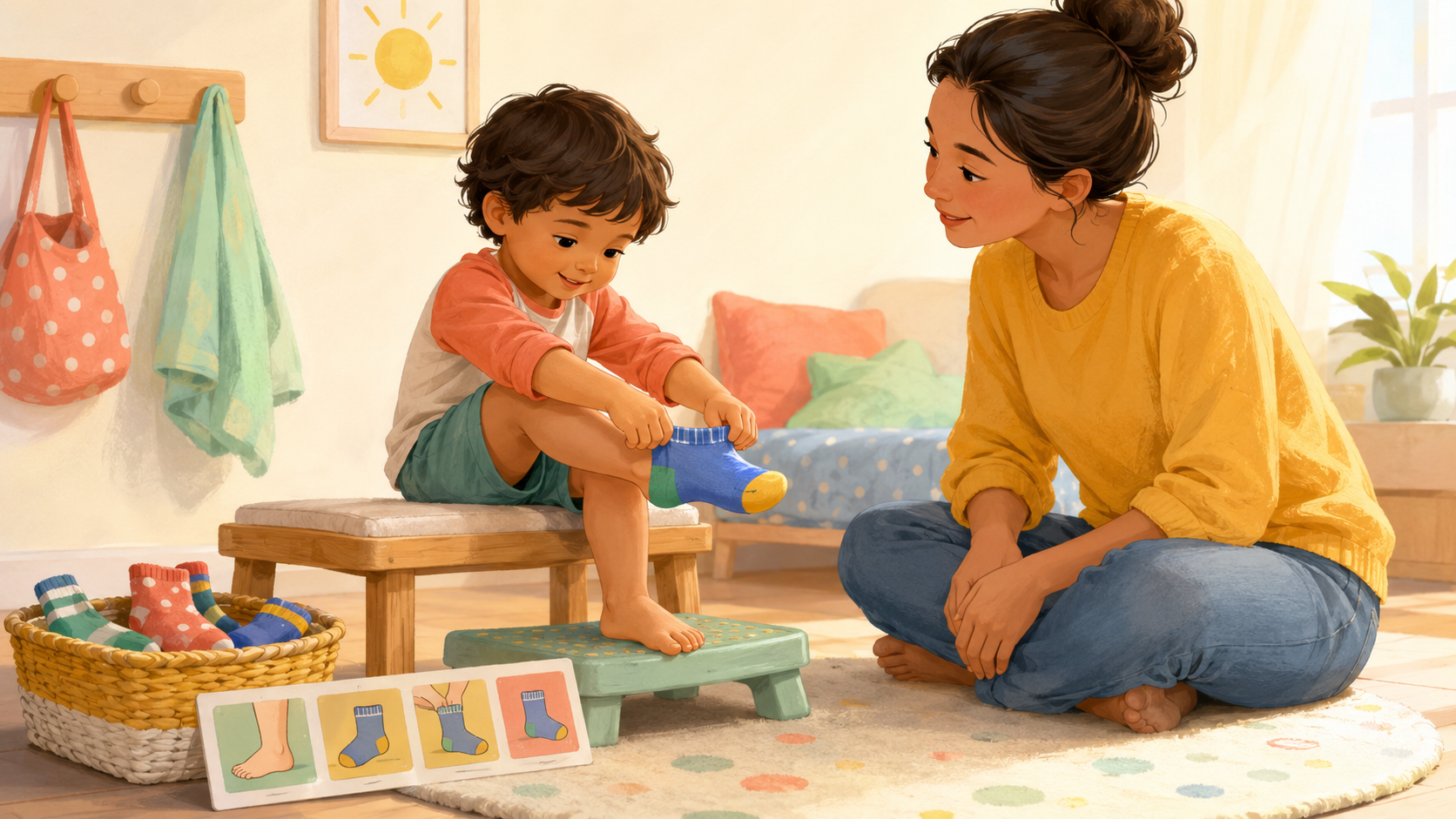
Putting on socks looks like one small dressing task, but a preschooler must balance, find the heel, open a stretchy cuff, coordinate both hands, aim the toes, pull with enough force, and notice when the sock is twisted. Breaking the task into predictable parts lets children practice real independence without turning every morning into a struggle.
Why socks can be surprisingly difficult
Sock dressing combines balance, body awareness, hand strength, bilateral coordination, motor planning, and visual attention. The child also has to tolerate fabric sliding over the toes and seams touching the skin. Difficulty with one part can interrupt the whole sequence.
Watch where the task breaks down. Does your child lose balance, struggle to open the cuff, miss the toes, stop at the heel, or become uncomfortable with the fabric? That observation tells you what to practice.
Begin with an easier setup
Practice when there is no rush. Seat your child on a low, stable chair or bench with the back supported when possible. The working foot can rest on the floor, a low stool, or the opposite knee if the child can sit safely.
- Choose loose, stretchy ankle socks for early practice
- Avoid tight cuffs, slippery tights, and very long socks
- Turn the sock fully right-side out before starting
- Use a contrasting heel and toe so the parts are easy to see
- Practice with bare feet before adding pants with bulky cuffs
Teach the same five steps
Use the same brief words each time and show the movement slowly. Too many directions can make a motor task harder.
- Find the heel — turn the heel down
- Thumbs in — place both thumbs inside the cuff
- Open wide — stretch the cuff into a big circle
- Toes in — aim all toes into the opening
- Pull over the heel — tug the sock up and smooth it
Try backward chaining for quick success
Backward chaining means the adult completes the first parts and the child finishes the last step. Begin by placing the sock over the toes and heel, then let your child pull it up. Once that is easy, stop with the sock just below the heel so the child pulls it over the heel and up. Gradually leave more of the sequence for the child.
Finishing the task gives an immediate sense of success and helps the child learn what the completed action feels like.
Play three games that build the movement
Practice the hardest parts away from the morning routine, when socks can become playful tools instead of a demand.
- Open wide: stretch a clean adult sock over a small plastic container, large block, or toy foot
- Sock rescue: loosely tuck a large scarf into a sock and pull it out using both hands
- Match and orient: pair socks, find the heel, and place each pair with the heel facing down
Support sensory comfort
Some children notice seams, tight elastic, temperature, or fabric texture much more strongly than others. Discomfort is useful information, not misbehavior. Try changing one feature at a time and notice whether participation improves.
- Try seamless or flat-seam socks
- Turn socks inside out if the seam feels better that way
- Choose soft, familiar fabric and the correct size
- Remove tags and check for bunching inside the shoe
- Let the child choose between two acceptable pairs
Use cues that help without taking over
Wait five to ten seconds before stepping in. Then move from the least support to more support: gesture toward the heel, give one short phrase, demonstrate with another sock, hold the cuff open, or help with only the stuck part. Return control to the child as soon as possible.
Instead of saying “That is wrong,” try: “Where is the heel?” or “Show me which part needs help.”
What progress can look like
Independence develops in small steps. Progress may mean sitting safely, finding the heel, putting both thumbs inside, getting all toes into the opening, pulling with less help, smoothing a wrinkle, or calmly asking for assistance. Practice for a few minutes and stop before fatigue or frustration.
If sock dressing regularly limits getting ready, preschool participation, comfort, or family routines—or if there is pain, loss of skills, marked weakness, frequent falls, persistent use of only one hand, or intense sensory distress—consider discussing the concern with a pediatrician or pediatric occupational therapist. An OT can look at the child, clothing, positioning, sensory experience, and the complete dressing routine.
Safety first
Practice seated on a stable surface away from stairs and sharp furniture. Stay close enough to prevent falls, and never leave a young child unattended on a changing table or elevated surface. Socks are not toys for covering the face and should be kept away from infants during sleep. Stop if the child has pain, numbness, skin color changes, breathing difficulty, or significant distress.
This article is for education and does not replace individualized medical or therapy advice. Stop any activity that causes pain or distress, and consult your child’s qualified provider when you have concerns.