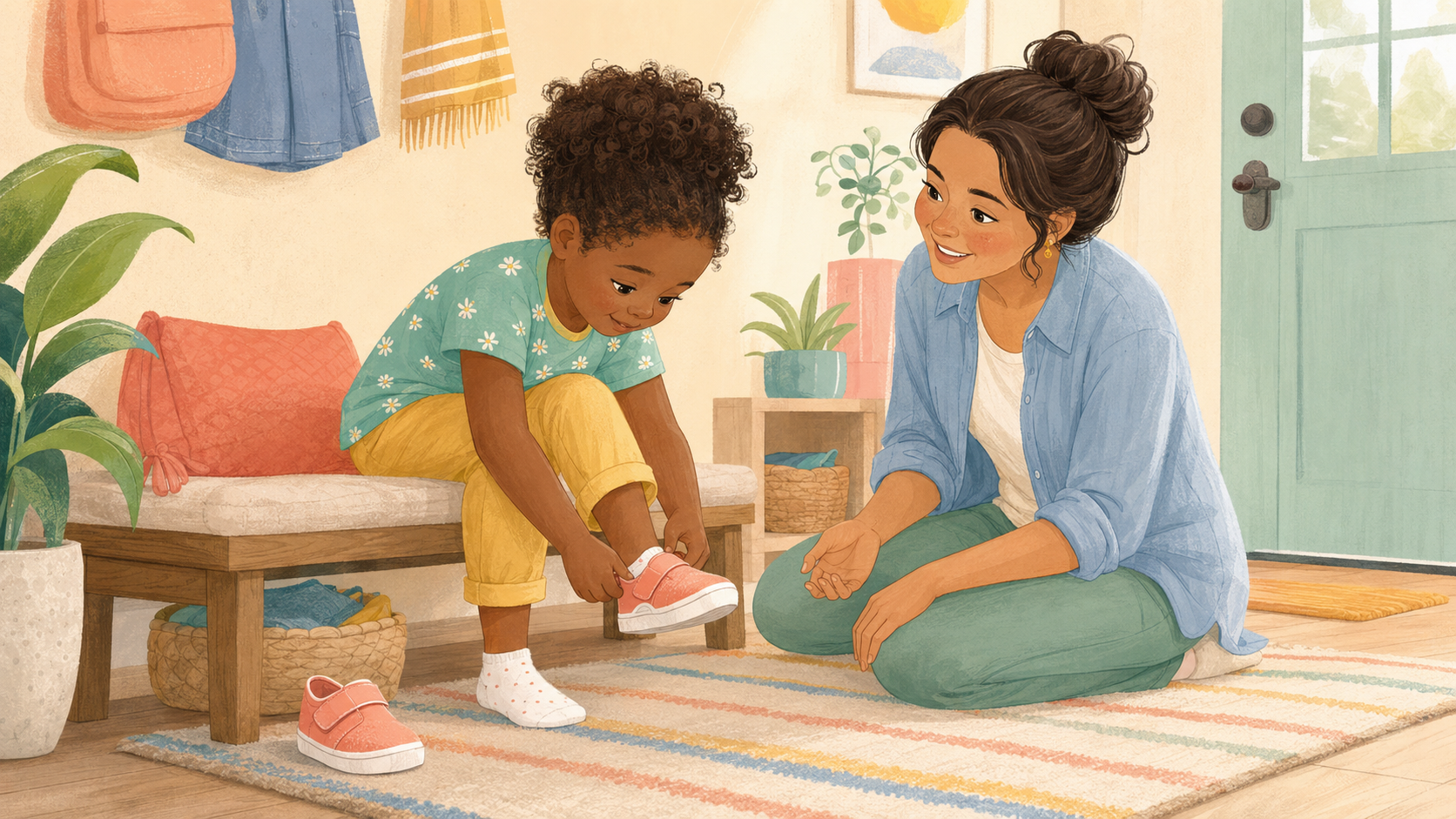
Putting on shoes asks a preschooler to balance, bend, orient the shoe, open it wide, guide the toes inside, push the heel down, and manage a fastener. Many children can complete part of the routine before they can do every step alone. Choose an easy shoe, create a stable setup, and teach one small movement at a time.
Choose shoes that make learning easier
Begin with lightweight slip-on or hook-and-loop shoes that open wide and have a flexible tongue, firm heel opening, and enough room for the foot. Tight, stiff, high-topped, or complicated shoes can hide what the child actually knows.
Check fit while the child is standing and follow the manufacturer’s sizing guidance. A comfortable shoe should stay secure without pinching or rubbing.
- Use one wide hook-and-loop strap before laces
- Choose a heel opening that holds its shape
- Practice with familiar socks
- Loosen every strap before starting
- Save tight boots and lace-up shoes for later
Create a stable starting position
Have your child sit on a low bench or sturdy chair with the back supported if needed. Bring one ankle onto the opposite knee, or place the foot on a low step where both hands can reach it. Put the shoes directly in front with toes pointing away.
Practice when there is no rush. A stable body leaves more attention for looking, planning, and using both hands.
- Use a nonslip floor
- Keep the other foot supported
- Provide good lighting
- Place left and right shoes in order
- Sit beside the child so your demonstration matches their view
Teach four short cues
Use the same brief words each time and demonstrate slowly on the other shoe. Pause after each step so the child has time to plan.
- Open — loosen the strap and pull the tongue forward
- Toes — point the toes into the opening
- Heel — push down and pull the heel of the shoe up
- Fasten — smooth and press the strap closed
Use backward chaining for an early success
Backward chaining means the adult completes the beginning and the child finishes the last step. Put the shoe fully on and let the child press the strap closed. Next, leave the heel partly out so the child pulls it up and fastens. Gradually hand over the earlier steps.
Offer only the amount of help needed, then reduce it as the movement becomes familiar.
- Adult puts shoe on; child fastens
- Adult guides toes in; child finishes heel and strap
- Adult opens shoe; child inserts foot and finishes
- Child completes all four steps with short cues
- Fade cues when the routine is remembered
Practice supporting skills through play
Putting on shoes uses two-handed coordination, hip flexibility, hand strength, visual attention, and motor planning. Short games can strengthen these foundations without repeatedly dressing.
- Open and close large hook-and-loop straps on a dressing board
- Pull wide elastic bands over a container
- Place rings over each foot while seated
- Post cards into a box using both hands
- Play a seated foot-tapping song: toes, heel, toes
- Put shoes on a doll or stuffed animal
Help with left and right
Preschoolers may not reliably know left from right. Place the inner edges together, add two halves of a removable picture inside the shoes, or use a cue such as “the straps point outside.” Let the child compare the shape before choosing.
If the shoes are reversed, respond neutrally and help switch them. Orientation develops through repeated meaningful routines.
- Store shoes together in the same direction
- Use a removable picture that meets in the middle
- Match the curve of each shoe to the foot
- Practice choosing before putting the shoe on
Support comfort and troubleshoot the exact step
Some children dislike seams, tight straps, pressure over the foot, or the feeling of a heel sliding in. Try familiar socks, loosen the shoe fully, and offer two comfortable pairs. Ask before touching the foot.
Watch where the routine stops. A child who cannot orient the shoe needs different help from one who cannot open the strap.
- Foot misses opening: widen and steady the shoe
- Heel stops: pull the tongue forward and loosen the strap
- Shoe falls off: check fit and secure the fastener
- Child cannot reach: raise the foot on a low support
- Strap is difficult: practice the final press separately
- Child tires: complete one shoe together
Safety and when to seek support
Use well-fitting shoes with secure soles and intact fasteners. Keep laces tied and avoid long loops or dangling cords. Check inside for small objects, rough seams, wetness, or damage. Stop for pain, blisters, persistent redness, swelling, numbness, limping, or significant distress.
Consider speaking with a pediatrician, podiatrist, or pediatric occupational therapist when shoe difficulties regularly affect dressing, preschool, outdoor play, or family routines; when the child avoids weight-bearing, falls often, uses one side very differently, loses a skill, or has ongoing pain. An OT can consider posture, reach, coordination, sensory comfort, motor planning, and the footwear itself.
This article is for education and does not replace individualized medical or therapy advice. Stop any activity that causes pain or distress, and consult your child’s qualified provider when you have concerns.