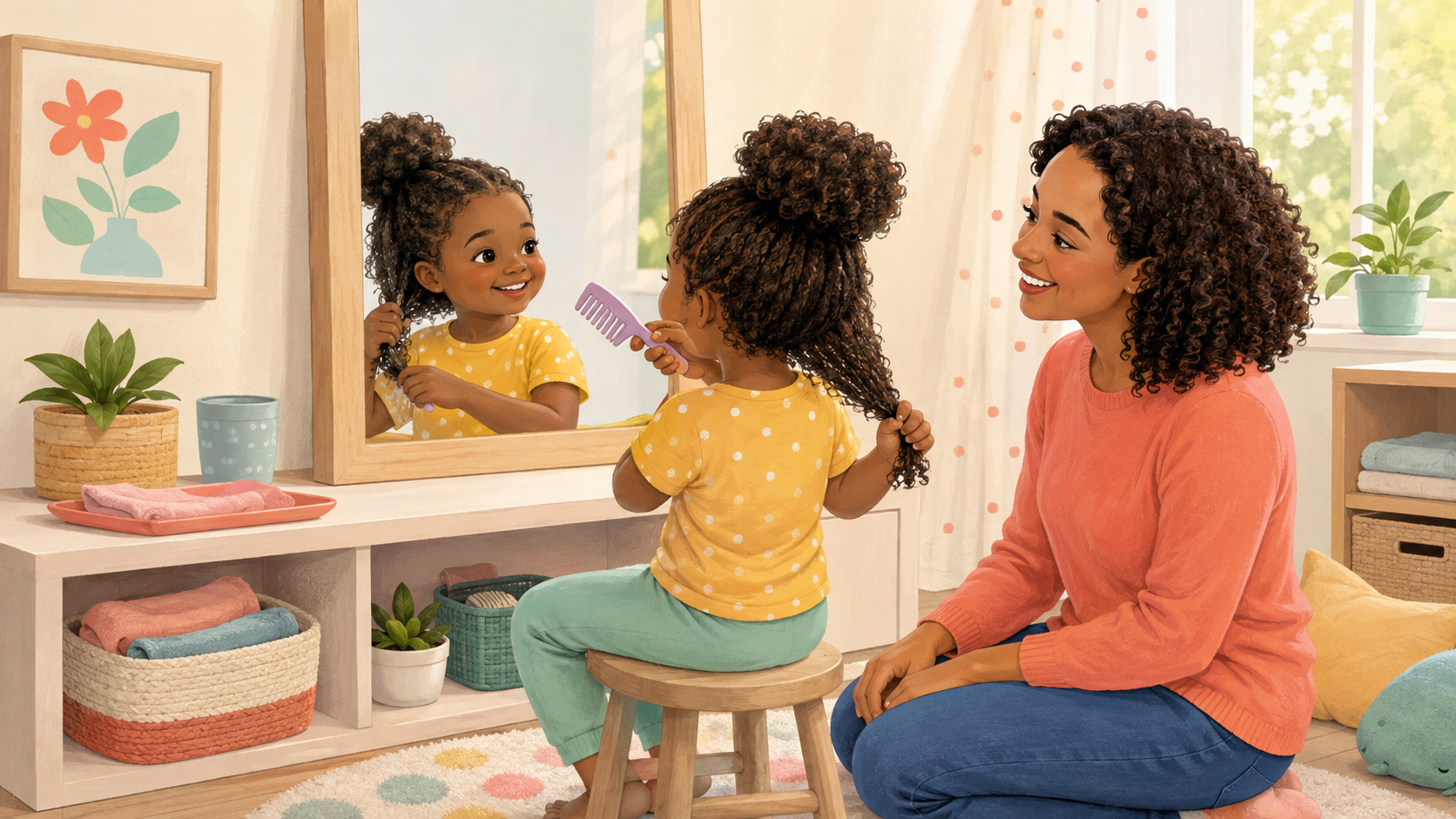
Hair brushing asks a preschooler to tolerate touch on the scalp, find tangles they cannot always see, use one hand to hold the hair while the other moves the brush, grade pressure, and remember a route around the head. The goal is not a perfect hairstyle. It is a calm, predictable routine in which the child can take on one more step at a time.
Choose tools and a setup that fit your child
Select a wide-tooth comb or a soft, flexible brush suited to your child’s hair texture and style. Use a child-sized handle, smooth rounded teeth or bristles, good lighting, and a mirror. Seat the child securely with feet supported and keep supplies in the same place.
The right tool differs for straight, wavy, curly, coily, braided, or otherwise styled hair. Follow the child’s usual hair-care plan rather than trying to brush through a protective style.
- Child-sized, easy-to-hold handle
- Smooth, unbroken teeth or bristles
- Stable low seat with feet supported
- Mirror and good light
- Caregiver nearby throughout
Prepare the hair and reduce pulling
Work with the hair damp or dry according to its texture and usual care routine. If appropriate, use only a child-safe conditioner or detangling product, follow the label, and keep it away from the eyes and breathing area.
Separate a small section and hold it above the tangle so the scalp is protected. Begin at the ends with short strokes, then move gradually upward.
- Separate one small section
- Hold the hair near the scalp
- Brush the ends first
- Move upward a little at a time
- Pause instead of pulling through a knot
Teach one simple sequence
Use the same brief words each time and demonstrate beside the child. A predictable sequence reduces the memory and planning demands.
- Sit — feet supported and body steady
- Hold — one hand holds the section
- Ends — brush the bottom first
- Up — move toward the scalp gradually
- Check — front, sides, back, and top
- Store — put the tool in its usual place
Use backward chaining for an early success
Backward chaining means the adult completes the beginning and the child finishes the last step. At first, section and detangle the hair, then let the child make the final two comfortable strokes and put the brush away.
Next, leave a larger tangle-free section for the child. Gradually transfer earlier steps while still helping with difficult areas or styles.
- Child puts the brush away
- Child completes the final strokes
- Child brushes one prepared section
- Child follows the head map with reminders
- Child completes the routine with an adult checking
Teach a simple map of the head
Children may brush the visible front repeatedly and miss the sides or back. Teach a route such as front, left side, right side, back, and top. Use a mirror and gentle touch cues only with permission.
For braids, twists, curls, or protective styles, teach only the parts that should be brushed or smoothed. Do not ask a child to undo or brush through a style that requires different care.
- Front or fringe
- Left side
- Right side
- Back
- Top or crown
- Final comfort check
Build the supporting skills through play
Low-pressure play can strengthen two-handed coordination, wrist control, sequencing, and body awareness without repeatedly working on the child’s hair.
- Brush a doll’s hair or a large yarn mane
- Hold a ribbon while sliding a wide comb along it
- Use one hand to steady paper while the other draws long strokes
- Copy front, side, back, and top in a body-parts game
- Put picture cards in brushing order
Support sensory comfort and predictability
Some children are sensitive to scalp pressure, light touch, product smells, spray sounds, static, or an adult standing behind them. Choose a consistent time, warn before each touch, and offer two acceptable choices such as brush or comb, chair or floor cushion.
Use firm, steady, gentle strokes rather than light tickling movements. Keep practice short, allow breaks, and use a visual timer or picture sequence if it helps.
- Tell the child before touching
- Offer a choice of safe tools
- Let the child hold the section when possible
- Pause at the first sign of pain
- Praise a specific step, not appearance
Safety and when to seek support
Use an intact brush or comb with rounded edges. Supervise clips and elastics, and keep scissors, razors, aerosol sprays, electrical cords, and hot styling tools out of reach. Do not share brushes when lice or a contagious scalp condition may be present, and clean tools according to their instructions.
Stop and seek appropriate medical guidance for pain, broken skin, swelling, persistent scalp irritation, unexplained hair loss, or a sudden change in tolerance. Consider a pediatrician or pediatric occupational therapist when hair care regularly limits hygiene, dressing, preschool participation, sleep, or family routines. An OT can consider sensory responses, posture, reach, two-handed coordination, motor planning, and the environment.
This article is for education and does not replace individualized medical or therapy advice. Stop any activity that causes pain or distress, and consult your child’s qualified provider when you have concerns.