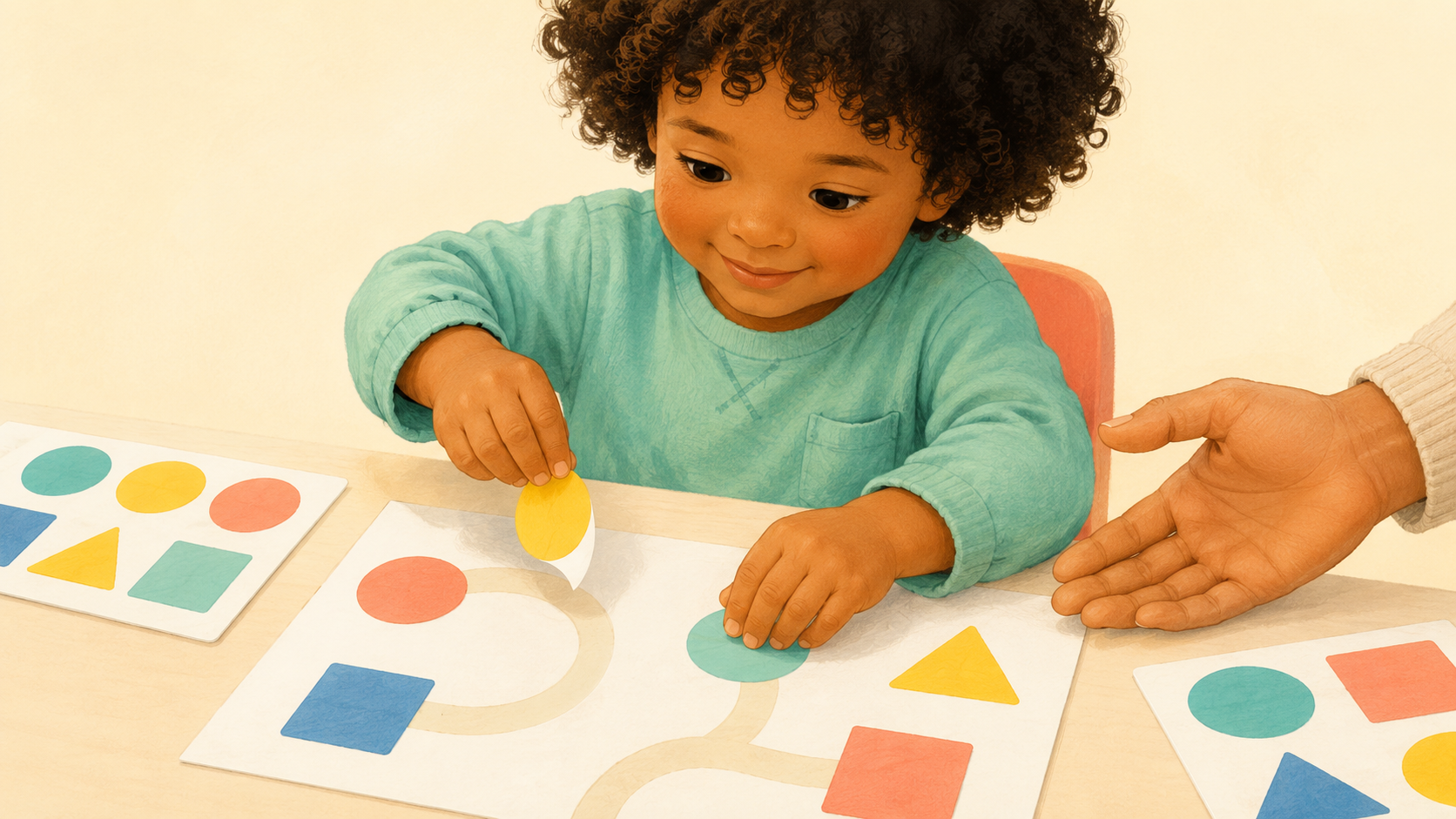
Peeling and placing a sticker may look like a tiny task, but it asks a child to find an edge, use the fingertips, stabilize the sheet with the helper hand, aim at a target, and release with control. Sticker play can offer short, motivating practice without asking a preschooler to produce a perfect drawing or pencil grasp. Choose large, age-appropriate stickers, stay close, and let success—not speed—guide the activity.
Prepare a safe, frustration-friendly setup
Choose large paper or reusable stickers that are labeled for the child's age. Avoid tiny foam shapes, gems, puffy pieces, magnets, sequins, or decorations that can detach. Inspect the sheet and discard torn backing, loose plastic film, staples, or damaged pieces.
Work at a stable table or on a low vertical surface. Offer only a few stickers at first. An adult can bend the backing beside one sticker or remove the surrounding waste paper to make the edge easier to find.
- Large age-appropriate stickers
- Sturdy paper or cardboard
- Crayon or washable marker
- Small tray for backing paper
- Adult supervision within reach
1. Finish the dotted road
Draw a wide road with five large dots. The child peels one sticker at a time and places it on each dot, moving from left to right.
Begin with a straight path. Later, try a gentle curve, a simple corner, or dots spaced slightly farther apart.
- Place one sticker on each dot
- Say ‘find, peel, place, press’
- Hold the page with the helper hand
- Drive a toy car along the finished road
2. Give the animal its spots
Draw a large ladybug, puppy, fish, or pretend animal with empty circles. Invite the child to add sticker spots.
Let the child choose between two colors. Choice supports participation while the repeated hand movement stays the same.
- Start with three spots
- Count each spot together
- Match stickers to colored circles
- Let the child decide where the final spot belongs
3. Build a sticker name
Write the child's first initial in a thick, simple line. Place a few large stickers along the line together. For younger children, use a circle, cross, or horizontal line instead of a letter.
This activity introduces the path and shape of a symbol without expecting the child to write it independently.
- Use one large uppercase letter
- Trace the line with a finger first
- Place stickers from top to bottom or left to right
- Say the letter sound or child's name naturally
4. Rescue the hidden pictures
Place large stickers loosely over parts of a familiar picture or on a reusable laminated scene. The child peels them away to reveal the animal, vehicle, or family member underneath.
Removing a sticker is often easier than lifting it from a full sheet, so this can be a useful starting activity.
- Reveal one part at a time
- Name what appears
- Put removed stickers on a discard card
- Use the other hand to hold the picture still
5. Sort colors into houses
Draw two or three large colored boxes. The child places each sticker in the matching ‘house.’ Keep the number of choices small enough that sorting does not distract from the hand skill.
If color matching is difficult, use identical pictures or let the child copy one example.
- Begin with two colors
- Place one sample in each box
- Turn the page so targets are easy to reach
- Celebrate careful looking and placing
6. Make a vertical sticker garden
Tape a large sheet of paper securely to a wall or easel at the child's chest level. Draw simple stems and let the child add large flower, leaf, or circle stickers.
A vertical surface changes the wrist and shoulder position while the child reaches, peels, and presses. Keep every target within a comfortable range.
- Reach up, across, and down
- Use the helper hand on the paper
- Add only five to eight stickers
- Finish with a crayon stem or grass line
7. Create a sticker story
Offer three to five large character or object stickers and one simple background. The child chooses what happens: the dog goes to the park, the bus stops at school, or the apple goes in the basket.
Ask open questions, but allow pointing or choosing without requiring a spoken answer. The fine-motor task can also support language, sequencing, and pretend play.
- Choose the first character
- Place it in the scene
- Add one action or location
- Tell the story together
- Put the finished page in a visible place
Adjust the activity and know when to seek support
To make peeling easier, lift one corner, use removable stickers, bend the backing, or place stickers partly off the edge of a tray. To increase the challenge, use a smaller target, a simple pattern, a vertical surface, or a reach across the middle of the body.
Stop if the child mouths materials, develops skin irritation, reports pain, becomes highly distressed, or cannot use the pieces safely. Consider discussing concerns with a pediatrician or pediatric occupational therapist when hand-skill difficulties regularly affect play, dressing, utensils, drawing, scissors, or participation in preschool.
- Easier: lifted edge, fewer stickers, larger targets
- Harder: smaller target, pattern, vertical reach
- Keep practice short and successful
- Praise the process: ‘You found the edge and used both hands’
This article is for education and does not replace individualized medical or therapy advice. Stop any activity that causes pain or distress, and consult your child’s qualified provider when you have concerns.