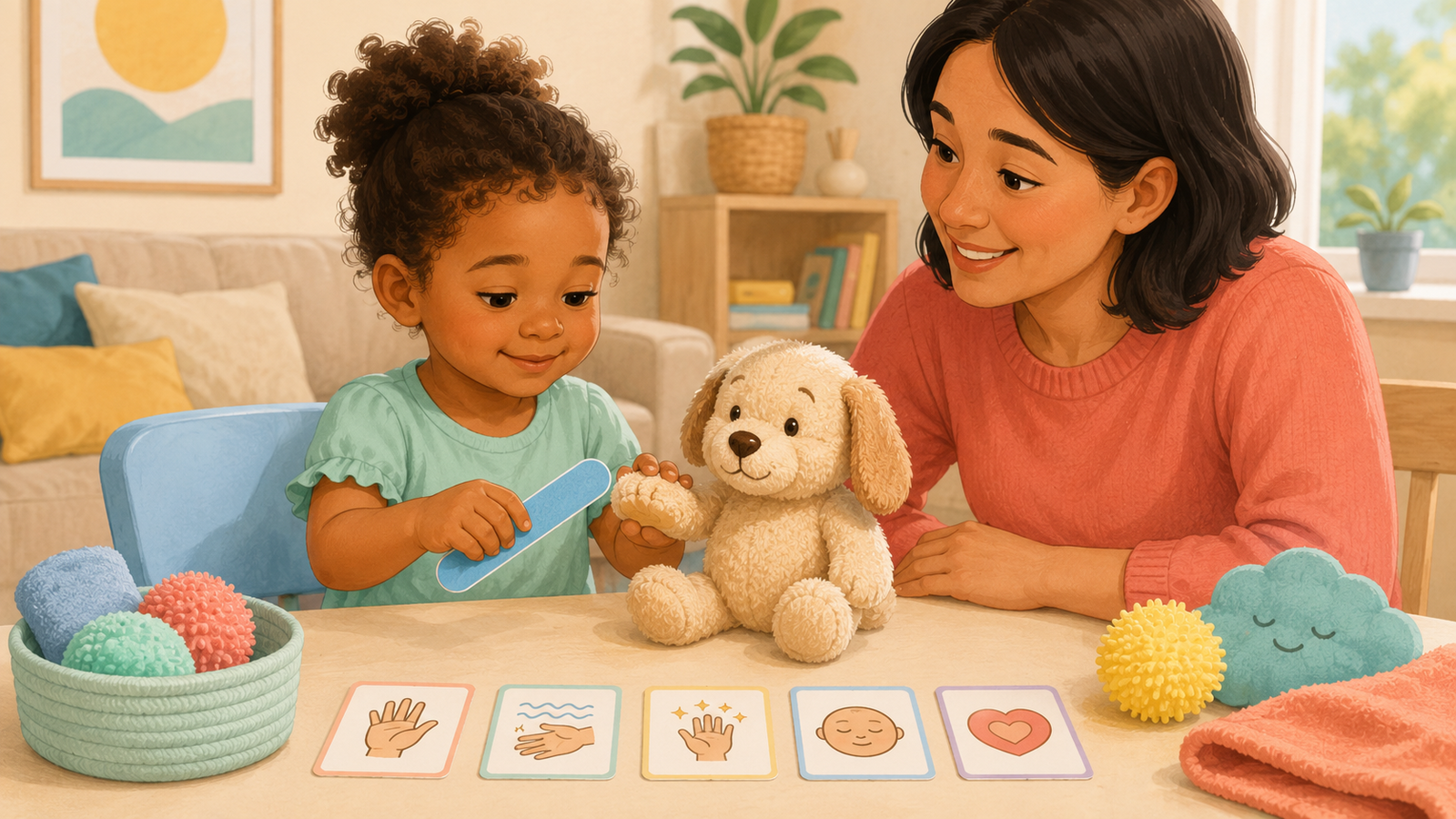
Nail care can feel surprisingly intense to a preschooler. It combines close touch, pressure at the fingertips or toes, an unfamiliar tool, a small clicking sound, the need to stay still, and uncertainty about what will happen next. Pulling away, hiding the hands, crying, or refusing does not mean a child is being difficult. These behaviors often communicate discomfort, fear, or a need for more predictability. The goal is safe participation—not perfectly trimmed nails in one sitting.
First, notice what is difficult
Observe which part of the routine changes your child's body language. A child may tolerate a nail file but fear clippers, accept fingernail care but not toenails, or dislike having one finger held at a time.
Look for early signals such as stiffening, pulling away, curling the toes, covering the hands, rapid breathing, or repeatedly asking what comes next. Responding early is usually easier than waiting for distress to become intense.
- Touch or pressure at the fingertips or toes
- The click, sight, or movement of the clipper
- Fear of pain or remembering a previous cut
- Difficulty keeping the hand or foot still
- A ticklish response
- Not knowing how many nails remain
- Dry skin, a hangnail, redness, or tenderness
Use a short visual routine
Show the sequence when your child is calm: wash and dry hands, choose a comfortable position, look at one nail, trim or file, check, and all done. Photos of your real setup can be more meaningful than generic pictures.
Use honest, concrete language. Say, ‘I will hold your finger gently. You may feel pressure and hear one click,’ rather than promising that the child will feel nothing.
- Keep the sequence to five or six steps
- Show how many nails you plan to do
- Mark each completed nail
- Include a pause card or hand signal
- Show the preferred activity that follows
Practice without trimming first
Begin with pretend play. Let the child care for a doll's hands, inspect a caregiver's nails, or move a closed clipper near a paper hand while an adult controls the real tool. Practice presenting one finger, holding still for two seconds, and then relaxing.
A child-safe nail file can help some children learn the routine with less sound and less sudden pressure. File only a little at a time and stop if the skin becomes irritated.
- Touch each fingertip with a soft cloth
- Count fingers and toes
- Practice ‘hold — check — release’
- Let the child choose which hand goes first
- Rehearse one brief click away from the body
- Finish after one successful practice turn
Prepare the body and position
Choose a time when your child is rested and not rushing. Some children do best after a bath because nails may be softer; others dislike nail care when the skin is damp. Follow your child's response and your healthcare professional's advice.
Use a stable, well-lit position in which both the child and adult are supported. Keep the hand or foot close to the child's body instead of pulling the limb outward.
- Feet and trunk supported
- Good light without glare
- Adult can see the nail clearly
- Comfortable hand or foot position
- Towel underneath to catch clippings
- No pets, siblings, or moving distractions nearby
Offer meaningful choices and control
Offer two choices that do not change the safety boundary. The child might choose fingers or toes first, file or clipper when both are appropriate, a song or quiet video, or one nail now and another later.
Agree on a clear stop signal. When the child uses it, pause and acknowledge the communication. A trusted pause makes future participation more likely.
- Right hand or left hand first?
- Sit beside you or on your lap?
- Count aloud or stay quiet?
- One nail or two nails?
- Brush clippings away or use a towel?
Complete one nail at a time
Tell the child what will happen immediately before it happens. Hold the finger or toe gently but securely enough to see the edge. Trim only the free edge and use small, controlled movements. Release the finger between nails.
Keep praise specific: ‘You held your finger still for one click,’ or ‘You showed me when you needed a pause.’ Avoid distracting a child so completely that the touch becomes a surprise.
- Check the skin and nail before beginning
- Use clean, appropriate grooming tools
- Keep the tool visible if that helps predictability
- Pause after each nail
- Brush away clippings promptly
- Accept a partial session as success
Adjust the plan to the child's response
If clicking is difficult, consider a suitable nail file or a quieter tool recommended for the child's age. If touch is difficult, practice brief fingertip massage or towel pressure at a separate calm time—only when the child accepts it.
If waiting is difficult, show exactly how many nails remain. If toenails are harder, complete fingernails and toenails on different days. Change only one part of the plan at a time so you can learn what truly helps.
- Easier: one nail, longer pauses, familiar location
- More predictable: visual count and same words
- Less tactile input: remove clippings immediately
- More control: child selects the next nail
- Shorter routine: spread care across several days
When to seek additional support
Speak with a pediatrician when nail care is painful, the skin is injured or infected, nails look unusual, a nail is ingrown, or there are medical conditions affecting circulation, sensation, skin, or healing. Do not attempt to treat a medical nail problem through home sensory activities.
Consider a pediatric occupational therapist when grooming distress regularly affects bathing, dressing, tooth brushing, hair care, sleep, preschool participation, or family routines. An OT can consider sensory responses, motor control, communication, positioning, tools, and the environment.
- Describe what triggers the response
- Share what the child can already tolerate
- Explain how daily participation is affected
- Bring the visual routine or supports you have tried
- Ask which concerns need medical assessment
This article is for education and does not replace individualized medical or therapy advice. Stop any activity that causes pain or distress, and consult your child’s qualified provider when you have concerns.