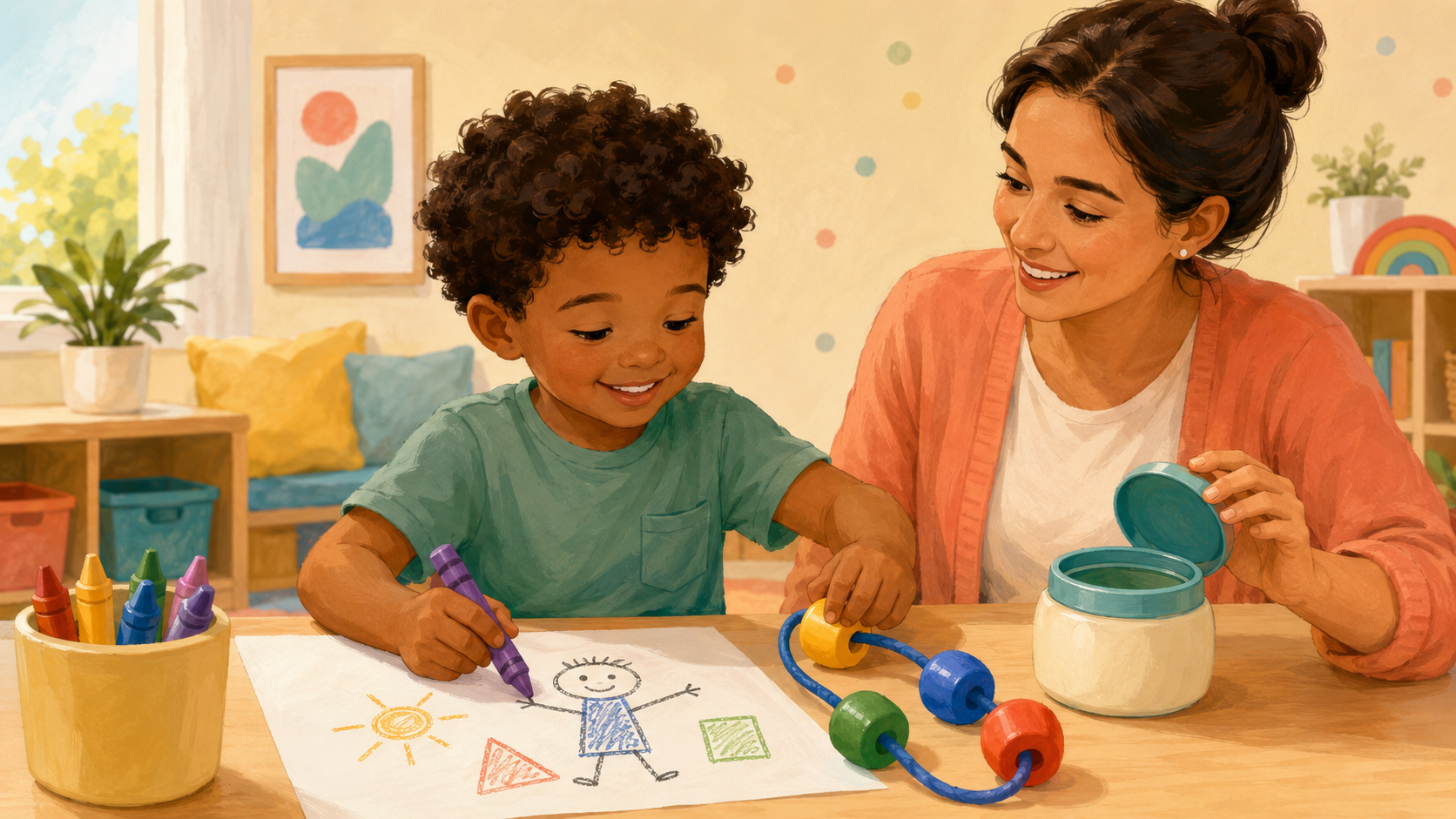
At 4, children are still learning how to coordinate the shoulders, arms, hands, eyes, and two sides of the body. Skills develop at different rates, so use these examples as a flexible guide—not a pass-or-fail checklist.
What fine motor development may look like at 4
Look at how your child participates during real play and routines. Comfort, curiosity, and growing independence are more meaningful than a perfect pencil grasp or a single finished product.
- Draws simple shapes and an emerging person
- Uses one hand to work while the other steadies paper
- Cuts short lines with supervised child-safe scissors
- Manages simple containers and large fasteners
- Builds more detailed block or construction designs
Easy activities to try
Choose one activity, keep it playful, and stop before hands are tired. Five enjoyable minutes repeated through the week is often more useful than a long drill.
- Draw roads and simple shape pictures
- Thread oversized beads on thick cord
- Use tongs to move large soft items
- Make playdough creatures with tools
- Practice opening lunch containers
Build the foundations, not just the fingers
Hand skills depend on stable posture, shoulder strength, touch awareness, vision, and bilateral coordination. Floor play, climbing, carrying light objects, and helping with household routines can support these foundations.
- Feet and trunk supported at the table
- Paper or toy positioned near the body's center
- One hand stabilizes while the other works
- Materials are large enough for success
How adults can help without taking over
Model one step, wait, and offer only as much help as needed. Break a task into small parts and celebrate effort, communication, and problem solving.
- Offer two manageable choices
- Use short directions
- Allow extra time
- Make the task easier after repeated frustration
- Return to a harder step another day
When to ask for support
Talk with your child's pediatrician or a pediatric occupational therapist when hand skills consistently limit play, dressing, eating, preschool tasks, or family routines; when an activity causes pain; or when a child loses a skill they previously used.
- Describe the daily activity that is hard
- Notice fatigue, frustration, pain, or avoidance
- Share what helps and what makes the task harder
This article is for education and does not replace individualized medical or therapy advice. Stop any activity that causes pain or distress, and consult your child’s qualified provider when you have concerns.