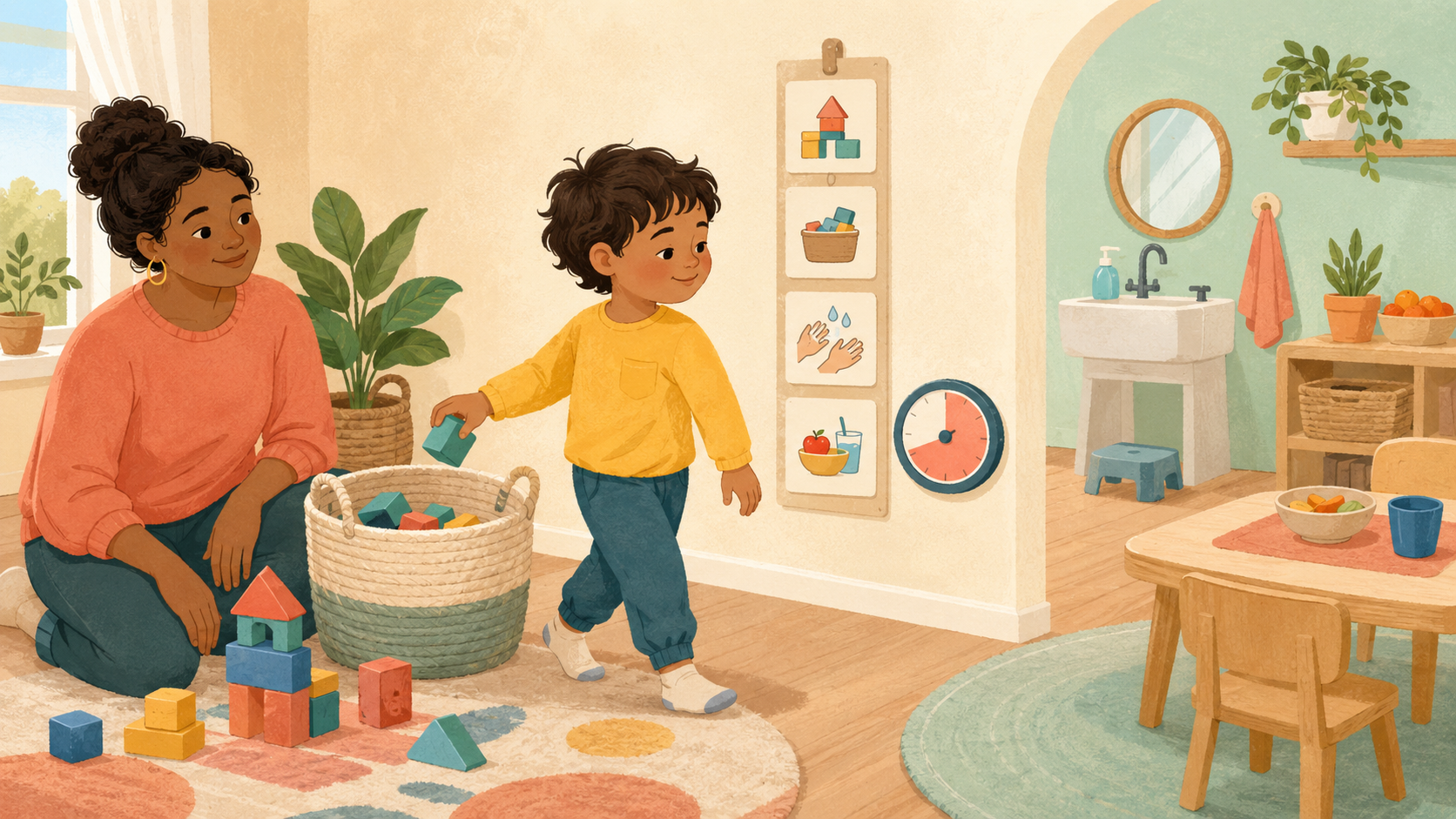
Stopping a favorite activity and moving into something new asks a preschooler to shift attention, manage disappointment, understand time, organize the next steps, and regulate the body—all at once. A difficult transition is not automatically defiance. Predictable cues, fewer words, and a small role in finishing can help a child move forward with greater confidence.
First, identify the transition—not just the behavior
Notice exactly where the difficulty begins. Is it when play ends, when shoes come out, when the room becomes noisy, or when the next activity is unclear? A child who can transition easily at one time but struggles when tired, hungry, rushed, or overstimulated may need a different amount of support in those moments.
Write the transition as two concrete points: “blocks to handwashing” or “car to preschool,” rather than “doesn’t listen.” This makes the problem easier to understand and change.
1. Show what is ending and what comes next
Young children often understand a picture or object more quickly than a long explanation. Show two simple images, point to the next location, or hold up the object needed for the next routine.
- Use two photos: “play” and “bath”
- Show shoes before it is time to leave
- Place the lunchbox near the door as a cue
- Turn over or remove the finished picture
- Keep the visual at the child’s eye level
2. Give one useful warning
A warning helps the child prepare, but many repeated countdowns can become background noise. Use one or two consistent cues that your child can understand. A visual timer may help because the passing time can be seen rather than imagined.
- “Two more minutes, then clean up”
- “One more turn, then shoes”
- Show a timer with a clear colored section
- Use the same short cleanup song
- Stand nearby when the warning is almost finished
3. Give the child a finishing job
An abrupt stop can feel unfinished. Offer one meaningful action that closes the activity: park the cars, place the last block in the basket, tuck in the doll, or carry the book to the shelf. Then acknowledge the finish and move on.
Avoid adding many cleanup steps if cleanup itself is the hard part. The goal is a clear ending, not a perfectly organized room.
- “Choose the last toy for the basket”
- “Press the light switch when we are ready”
- “Carry the towel to the bathroom”
- “Wave goodbye to the playground”
4. Use first-then language
First-then language makes the sequence small and predictable. State what needs to happen first and what naturally follows. Keep your voice calm and use the same order shown in the visual cue.
- “First diaper, then book”
- “First shoes, then car music”
- “First wash hands, then snack”
- “First two toys away, then outside”
5. Add a short body job before moving
Some children transition more smoothly after purposeful movement that gives the muscles and joints clear feedback. Choose a brief job that fits naturally into the routine rather than a long exercise break.
- Push the toy bin to the shelf
- Carry a small backpack or stack of towels
- Do five wall pushes before dressing
- Walk like a bear to the bathroom
- Pull a laundry basket toward the bedroom
6. Reduce words and offer one small choice
When a child is already upset, extra explanations and questions add more information to process. Use one short direction, pause, and point or gesture. Offer a choice only when both options truly work.
- “Shoes now. Red or blue?”
- “Walk or hold hands?”
- “Carry the cup or the napkin?”
- “Hop or tiptoe to the bathroom?”
7. Stay connected through a hard transition
A child may still cry, protest, or need physical closeness even when the plan is clear. Name the feeling briefly while holding the boundary: “You wanted more play. It is hard to stop. I’m here. Now we are going to the bath.” Calm support helps the child borrow regulation while the routine continues.
Afterward, reconnect without a lecture. Notice recovery: “That was hard, and you came with me.” Later, adjust the warning, visual, or finishing job based on what you learned.
Build one repeatable transition routine
Choose one transition that happens often and practice the same sequence for one or two weeks: show the cue, give one warning, complete one finishing job, say first-then, and move. Change only one part at a time so you can tell what helps.
Progress may look like a shorter protest, fewer prompts, walking with the adult, recovering faster, or completing one step independently. A transition can be successful even when the child is disappointed.
- Keep the routine short enough to repeat
- Prepare needed items before giving the warning
- Use the same words across home and preschool when possible
- Plan extra time during difficult parts of the day
- Praise the specific skill: “You checked the picture and put the last block away”
Safety and when to seek support
Keep transition paths clear of stairs, traffic, hot surfaces, water, and breakable objects. Provide close supervision in parking lots, near streets, and during climbing or movement activities. Do not pull a child by the arm, restrain the child as a routine strategy, or use movement as punishment. During an immediate safety risk, move to safety first and explain later.
Consider discussing transitions with a pediatrician, early childhood team, or pediatric occupational therapist if distress is frequent or intense, causes injury or unsafe running, lasts a long time, prevents preschool or family participation, disrupts sleep or eating, or occurs alongside a loss of skills or other developmental concerns. A professional can look at communication, sensory needs, routines, motor demands, and the child’s environment together.
This article is for education and does not replace individualized medical or therapy advice. Stop any activity that causes pain or distress, and consult your child’s qualified provider when you have concerns.