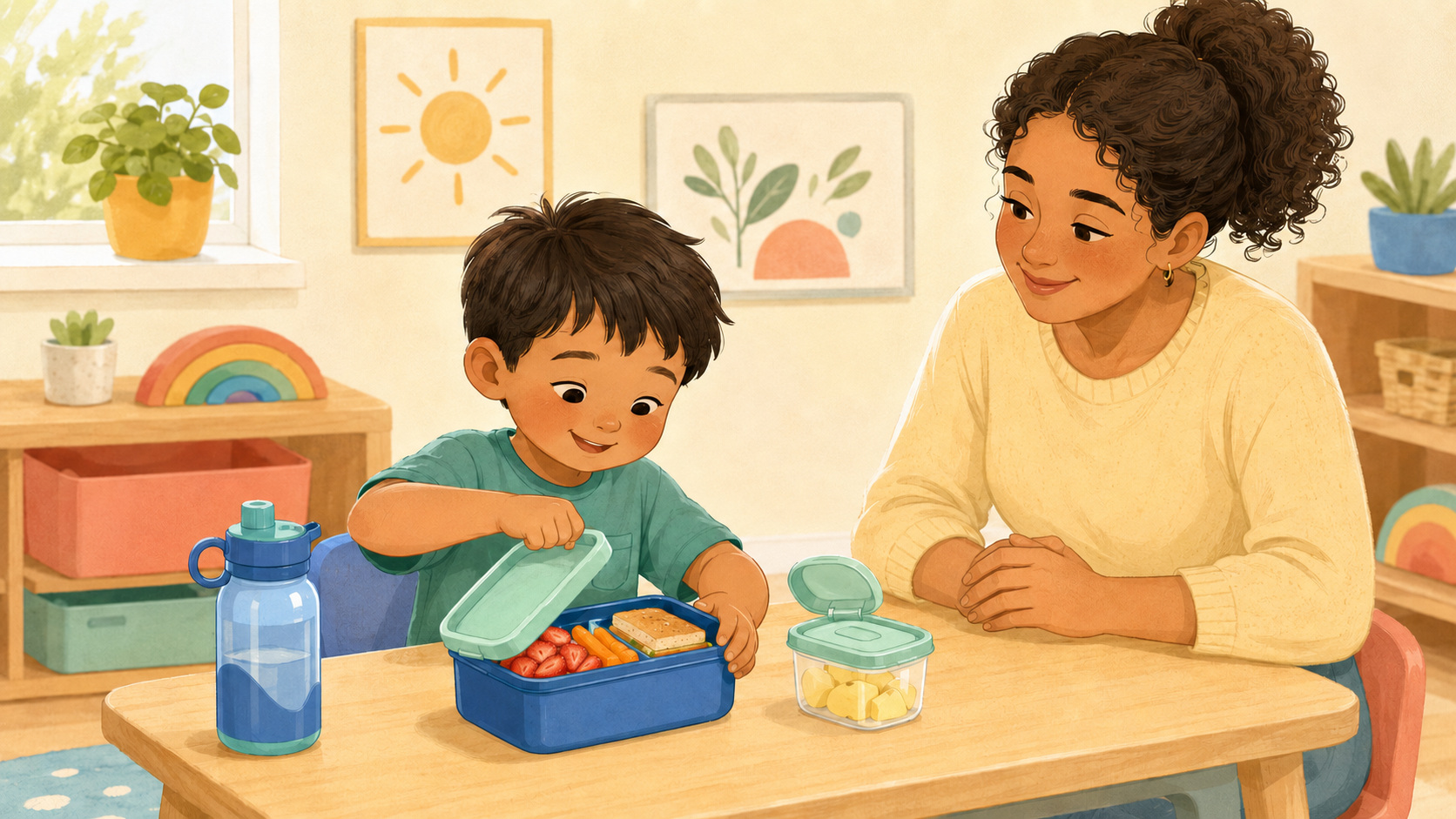
Opening a lunchbox looks simple to an adult, but it asks a young child to coordinate two hands, use the right amount of force, plan several steps, and keep trying when a lid feels stuck. Practicing these skills before preschool can make mealtime less frustrating and give children more time to eat, talk, and participate with their classmates.
Why lunch containers can be difficult
A child usually needs one hand to hold the container still while the other hand pulls, twists, peels, or lifts. This is called bilateral coordination. The task also uses hand strength, finger control, visual attention, motor planning, and the ability to grade force—enough pressure to open the package without spilling what is inside.
A child may manage one kind of lid and struggle with another. That does not mean the child is being careless or refusing. The container may simply demand a skill that is still developing.
Choose containers your child can learn to manage
Before packing a new lunch container, ask your child to try it at home. Some leak-resistant containers are so tight that even adults need significant force. Independence begins with a good match between the child and the container—not with expecting the child to overcome unsuitable packaging.
- Look for large, visible tabs and wide zipper pulls
- Choose lids with a clear place for the fingers to grip
- Use containers that stay stable on the table instead of sliding
- Pack at least one familiar, easy-to-open item each day
- Avoid filling containers so tightly that pressure makes the lid harder to remove
1. Practice hold-and-pull with non-food play
Place a few favorite toys or large craft items in a clean zippered pouch. Encourage your child to hold the pouch with one hand and pull the zipper with the other. You can also hide picture cards inside easy snap-lid boxes and turn opening them into a search game.
- Start with the zipper or lid partly open
- Add a ribbon loop to a small zipper pull when needed
- Place a nonslip mat under containers that move
- Practice for three to five minutes, then stop while it is still successful
2. Teach the hands different jobs
Young children often try to open a container with both hands doing the same thing. Give each hand a simple job: “Helper hand holds. Working hand pulls.” Place your hand lightly over the helper hand only if the container keeps moving, then reduce your help as soon as the child understands the pattern.
3. Build twist-lid skills during everyday routines
Twisting requires the hands to rotate in opposite directions. Practice with clean empty jars, large reusable bottles, bath-toy containers, or screw-top play sets. Begin with the lid loosened so one small turn creates success.
- Draw a removable sticker dot on the lid and container to show where to start
- Practice opening and closing rather than tightening as hard as possible
- Use short directions: hold, turn, lift
- Keep glass containers and medication bottles out of play
4. Rehearse the whole lunch routine
Once or twice before school, pack a small practice lunch and sit at a child-sized table. Let your child unzip the lunchbox, remove the containers, open one item at a time, manage wrappers, and put everything back. A complete rehearsal helps children learn the sequence, not only the individual hand movements.
- Use the same lunchbox and containers planned for school
- Practice opening the water bottle without tipping it
- Teach where wrappers and unfinished food should go
- Include enough time to eat; independence should not become a race
Use the least help that works
Pause for five to ten seconds before stepping in. If help is needed, move from less support to more support: point to the tab, give one short verbal cue, demonstrate on another container, start the lid slightly, or guide the child’s hands. The goal is to help the child finish the next step while still doing as much as possible independently.
Keep food safety and comfort in the plan
Wash reusable containers and practice materials thoroughly, follow safe food-storage guidance, and pack foods in textures and sizes your child can already manage safely. Check preschool allergy policies before sending food. Avoid sharp tools, glass, hard-to-open cans, and packaging that can tear into small pieces.
This article offers general educational ideas, not individualized medical, feeding, or occupational therapy advice. A child with coughing, choking, pain, loss of skills, or another safety concern needs guidance from a qualified healthcare professional.
When extra support may be helpful
Consider discussing concerns with a pediatrician or pediatric occupational therapist when difficulty opening containers consistently limits eating, school participation, or independence; when the child avoids using one hand; when tasks cause pain or marked fatigue; or when similar challenges affect dressing, handwashing, and play. An OT can look at strength, coordination, sensory responses, motor planning, positioning, and the demands of the child’s real routines.
This article is for education and does not replace individualized medical or therapy advice. Stop any activity that causes pain or distress, and consult your child’s qualified provider when you have concerns.