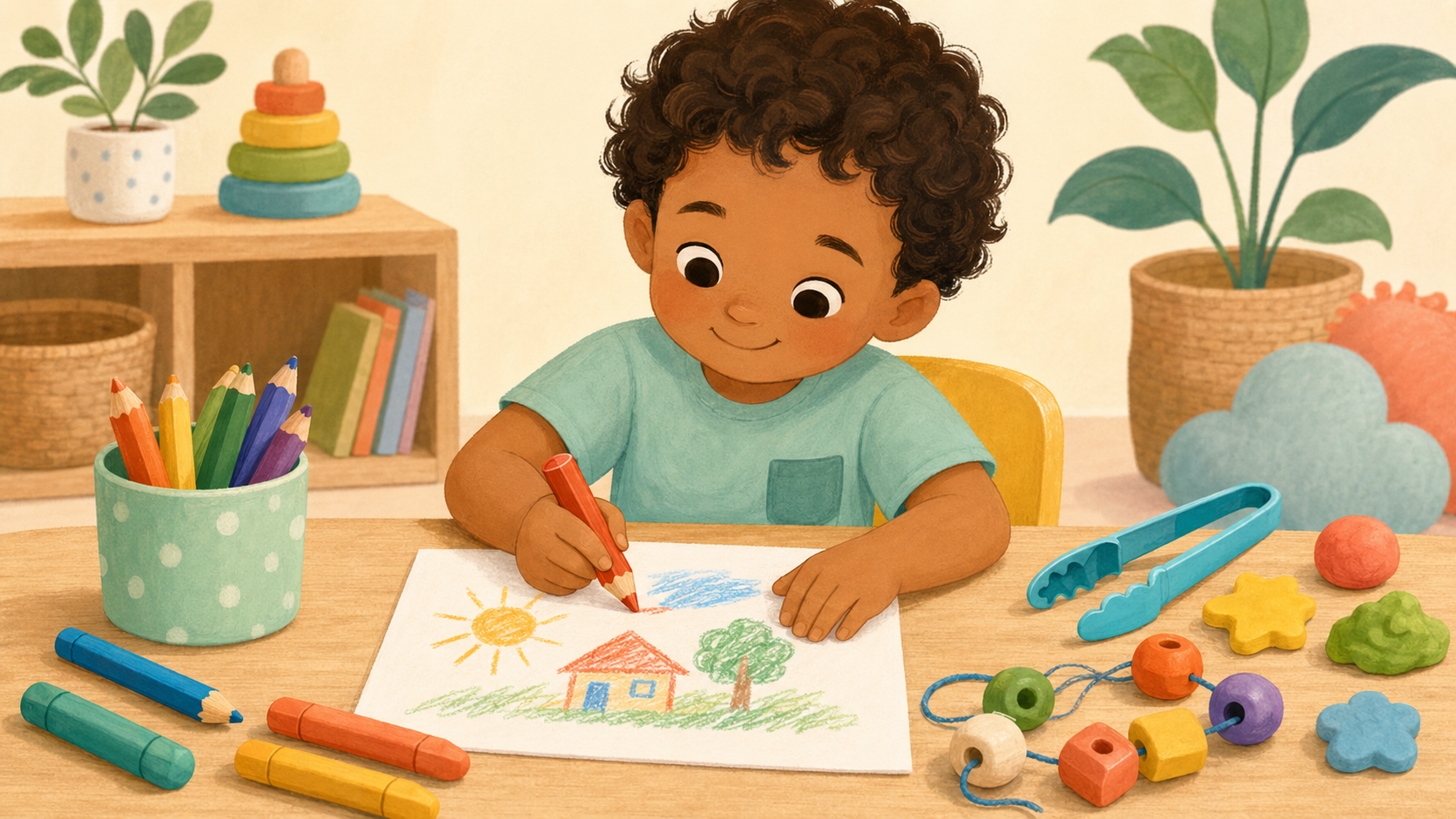
Parents often worry when a preschooler holds a crayon with the whole fist or uses several different grasps. But grasp develops over time. Young children need many experiences with climbing, building, pinching, drawing, and manipulating small objects before a more refined pencil grasp becomes efficient.
Grasp changes with development
Toddlers often hold drawing tools in a fisted grasp and move from the shoulder. As hand skills improve, children begin turning the fingers toward the paper and using more controlled finger movements. By kindergarten age, many children use a tripod or quadrupod grasp—but functional variation is common.
What makes a grasp functional?
- The child can make the marks or shapes expected for their age
- The hand is relaxed rather than tightly clenched
- The child can work for an age-appropriate time without pain or fatigue
- The child can see what they are drawing or writing
- The grasp allows controlled movement rather than using the whole arm for every mark
Use small drawing tools
Offer broken crayons, short chalk, small pencils, or rock crayons. A short tool naturally encourages children to use their fingertips because there is not enough space to wrap the whole hand around it.
Build the hand before correcting the fingers
These activities support finger strength, separation of the two sides of the hand, wrist stability, and visual-motor control—the foundations used during handwriting.
- Pinch and roll playdough
- Pick up pom-poms with tongs
- Thread large beads
- Use clothespins in pretend play
- Peel stickers and place them along lines
- Build with small interlocking blocks
- Draw on a vertical surface such as an easel
Check the setup
Place paper on a table that allows the child’s elbows to rest comfortably. Support the feet with the floor, a stool, or a box. For a right-handed child, angle the top of the paper slightly left; for a left-handed child, angle it slightly right. Good positioning often improves control immediately.
When to seek additional support
Consider speaking with a pediatric or school-based occupational therapist when grasp significantly limits participation—for example, the child avoids drawing, experiences pain, presses so hard the paper tears, cannot make expected pre-writing forms, or becomes tired much faster than peers. An OT looks beyond grasp to posture, strength, coordination, vision, sensory processing, and task demands.
The bottom line
Give preschoolers abundant, joyful opportunities to use their hands. Model a helpful grasp once, offer an appropriate tool, then let the child create. Strong foundations and positive practice are more valuable than constant correction.
This article is for education and does not replace individualized medical or therapy advice. Stop any activity that causes pain or distress, and consult your child’s qualified provider when you have concerns.